


Blemishes in Raw Jadeite—A Detailed Explanation of the Characteristics of Various Blemishes
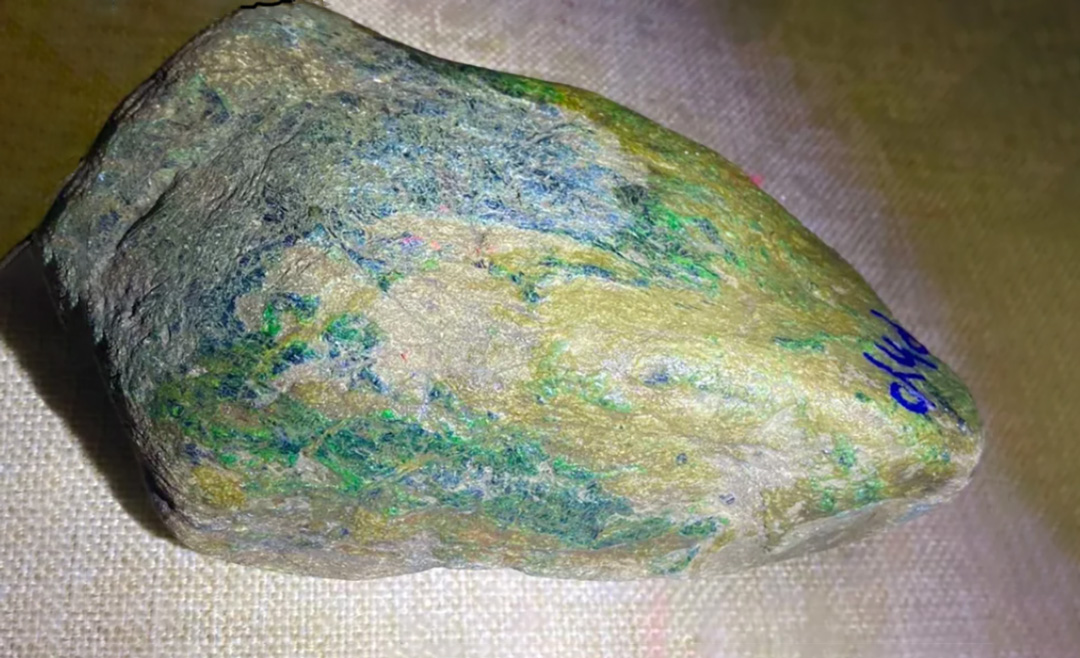
In the jadeite “gambling stone” industry, “mold” is a central concept that cannot be ignored. It is not only the most conspicuous black mark on the skin of a rough stone, but is also often regarded as a “pathfinder” or “destroyer” of the green inside.Resembling psoriasis, “suan” appears on the surface of jadeite rough stones or their outer skin and is one of the most damaging defects in jadeite rough. The depth of one's understanding of “suan” often determines the success or failure of a jadeite gambling transaction.This article will begin with its mineralogical origins and systematically organize the names, colors, morphological characteristics, and reference value of all known types of “suan” for jadeite gambling.
I. The Causes of “Shan”: The Dark Transformation of Chromium
Essentially, “psoriasis” refers to dark mineral aggregates formed on the surface and within jadeite during its lengthy diagenetic and metamorphic processes, resulting from multiple phases of hydrothermal activity.Their main components include amphibole minerals (such as kyanite and nairobite), sodium-chromium pyroxene, chlorite, and small amounts of green pyroxene.
The green color of jadeite originates from chromium (Cr³⁺) ions replacing aluminum(Al³⁺) in the jadeite crystal lattice through isomorphous substitution. When chromium-bearing hydrothermal alteration proceeds just right, chromium ions successfully enter the jadeite lattice, producing a vivid green color.However, if the concentrations of chromium, magnesium, iron, and other elements in the hydrothermal fluid become too high, or if the physicochemical conditions undergo drastic changes, these excess color-forming elements cannot fully incorporate into the jadeite and instead crystallize independently, forming clusters of dark black or grayish-black amphibole or sodium-chromium pyroxene.This is the geochemical origin of “black spots.”
Precisely for this reason, “black spots” and green color share a common origin and coexist symbiotically, giving rise to the most famous rule in the jadeite industry—“green follows black” or “black relies on green for its existence.”While “black spots” are a companion to green, they can also, conversely, leach out or consume the existing green, resulting in the phenomenon of “black spots devouring green,” which completely diminishes the jadeite's value.
II. Types, Characteristics, and Value of “Xuan” in Uncut Jade
Within the industry, “black spots” are subdivided into more than ten types based on their morphology, color, mode of intrusion, and impact on the internal jade quality, with each type having its own unique criteria for evaluation.
1. Black Spots (Wu Xian) — A Matter of Life and Death
-
Color and Shape: Deep black to dark green, often appearing in blocks, clumps, or coarse bands, with relatively distinct boundaries.
-
Characteristics: Black spots themselves hold great value and are classified as “live spots” and “dead spots.”Under a strong flashlight, if a distinct emerald green hue shines through the edges of a black mass, or if the spot itself has a faint green tint, it is considered “Live Spot,” indicating sufficient chromium replacement and the potential for green coloration;if the area appears pitch black under the light, dry, and lacking any “water head,” it is “dead spots,” devoid of any green vitality.
-
Value in Jadeite Gambling: “Live spots” are one of the primary indicators for predicting green, but one must be cautious to ensure they have not penetrated the entire interior and depleted all the green; “dead spots,” on the other hand, are worthless and should not be gambled on at all.
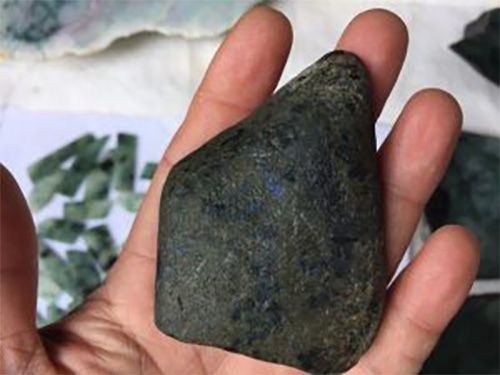
2. Pig Bristle Inclusion — Like a Needle Piercing the Flesh
-
Color and Shape: Black, appearing as clusters of fibrous, needle-like aggregates that pierce straight into the jade's flesh like pig bristles.
-
Characteristics: This type of “mold” penetrates deeply along cleavage planes or micro-fractures, causing extreme damage; it pierces the jade flesh until it is riddled with holes, leaving no intact sections from which to extract usable material.
-
Value in Jade Gambling: The failure rate is extremely high; even if green is visible in the surrounding area, it is impossible to extract a bracelet or a large, plain piece, so it is generally considered a useless “dead fungus.”
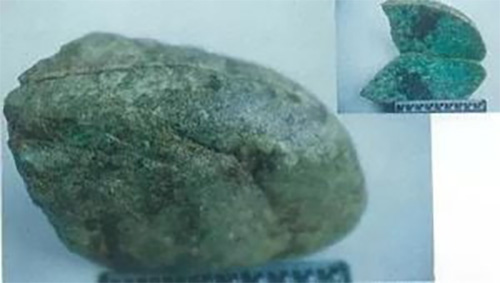
3. Vertical Fungus (Nail Fungus) — Penetrating to the Core
-
Color and Shape: Deep black, long columnar or nail-like in shape, penetrating the skin vertically or at an angle; cross-sections are often circular or elliptical in shape.
-
Characteristics: Similar to “pig bristle spots” but thicker; they penetrate extremely deeply, often piercing through the entire jade block. A faint trace of green may be present around them, but the jade flesh has already been pierced by the black “nails.”
-
Value for Uncut Jade: The interior is inevitably damaged; even if a green hue is visible when scraped, it is only a thin layer. It is extremely difficult to extract intact, pure-colored material, making this a highly risky prospect.
4. Horse-Tail-Like Inclusion — Scattered Internal Damage
-
Color and Shape: Grayish-black or dark brown; shaped like strands of a horse's tail spreading out, with a single thick vein branching into many fine threads at one end.
-
Characteristics: It spreads radially or in a trailing pattern throughout the jade body, often penetrating deep into the interior, causing the jade to become loose and riddled with impurities.
-
Value in Jade Speculation: It covers a large area and usually creates a widespread “dirty background” internally, making the chances of a successful bet slim; it is classified as a destructive type of blemish.
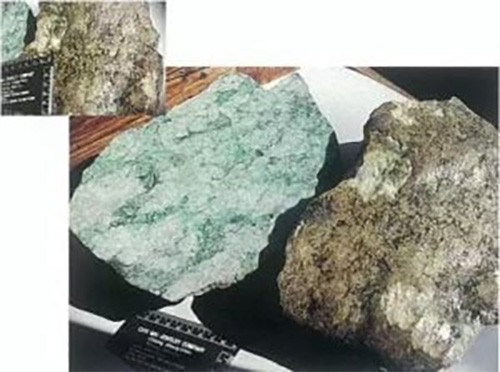
5. Dry Fungus — Dry Twigs on the Skin
-
Color and Shape: Dark gray-black or yellow-black, resembling withered branches or tree bark; mostly appears in patches or fine strips floating on the surface of the skin, with blurred edges; feels rough and dull to the touch.
-
Characteristics: Dry-wood mold resembles scorched bread crust; it adheres only to the surface without penetrating deeply or only penetrating slightly, appearing dry and brittle due to incomplete integration.
-
Value in Jadeite Rough: This is a relatively popular type of mottling. Because it often occurs alongside internal green bands and does not penetrate deeply into the stone itself, it frequently reveals large pockets of high-quality green beneath the surface. Simply rubbing away the dry mottling may reveal the green.
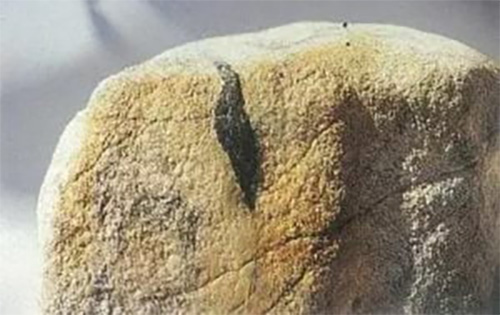
6. Gray Mottling — Dust in the Mist
-
Color and Shape: Gray or grayish-black, appearing in a misty or faint, flaky pattern spread over large areas of the skin or the shallow layers of the jade.
-
Characteristics: The transition of gray mold is relatively uniform but lacks clarity. While it does not strongly encroach on the green, it causes the entire jade's base color to turn gray and darken, resulting in a dull translucency.
-
Value in Jadeite Speculation: Once cut, these stones are often low-grade with a gray base and irregular coloration. Even if fully colored, their value plummets due to the grayish tint, making them a low-risk bet.
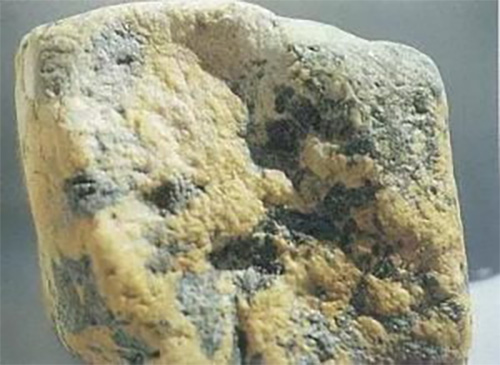
7. “Plaster-like” Fungus — Green Appears Upon Application
-
Color and Shape: Jet-black, appearing as flat, patch-like formations, resembling a plaster patch adhered to the surface of the rough jade's skin; it has some thickness but covers a limited area.
-
Characteristics: The “Plaster Patch” penetrates only very shallowly, mostly existing only in the outer layer; immediately beneath it, there is often a layer of rich green.
-
Gambling Value: A classic example of a high-quality “mold.” As long as the assessment is accurate—confirming that the “mold” has not penetrated deeper—scraping away this black outer layer reveals a high probability of clumps of green beneath, making it one of the classic types of bets that yield significant returns.
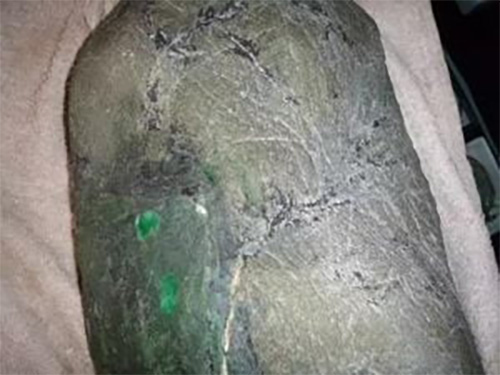
8. Spotted Mottling (Leprous Mottling, Leprosy Mottling) — Scattered Spots
-
Color and Shape: Black or blackish-green, appearing as spots or small granules of varying sizes distributed in patches, resembling the skin of a toad.
-
Characteristics: Black spots are scattered throughout the jade's flesh, varying in depth and intensity. If the spots are sparse and faint, they can be removed through carving; if they are dense and deep, the entire piece is considered tainted.
-
Value in Jadeite Gambling: Density and depth must be assessed. If the spots are few and only on the surface, there is a chance of uncovering green, unblemished jade; if they are dense and deep, the stone has no value.
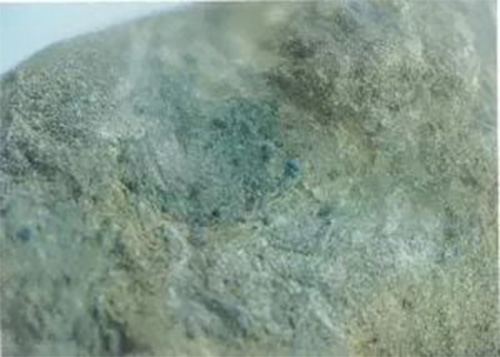
9. Fly Droppings — Tiny Impurities
-
Color and Shape: Extremely tiny black specks, resembling fly droppings, often appearing as scattered or dense clusters of sesame-seed-sized dots.
-
Characteristics: This type of blemish consists of the finest amphibole particles, often scattered throughout the entire rough stone and very difficult to remove completely.
-
Value in Bet Stone: This is a fatal flaw for high-color material, severely affecting clarity; the finished product will display a dense cluster of black spots. When betting on a stone, one should avoid such specimens as much as possible, or select only areas with dense clusters of deep green that contain only a small number of acceptable spots.
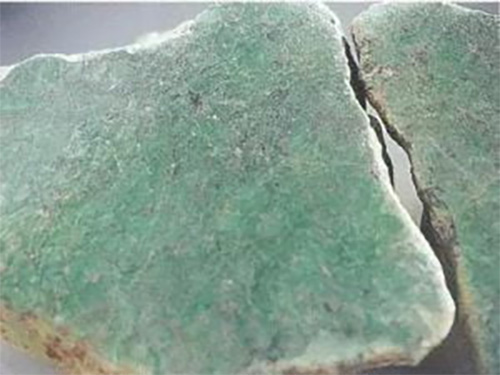
10. Buckwheat-Seed Inclusion — Flaky Husk-Like Inclusions
-
Color and Shape: Brownish-black or dark brown; resembling buckwheat husks, these appear as flat, small flakes or fragments scattered across the outer skin or along the edges.
-
Characteristics: Buckwheat-scale often runs parallel to the outer skin, penetrates to a moderate depth, and frequently makes the internal base appear “dirty.” However, it sometimes interweaves with green, forming a “scale-intermixed-with-green” pattern.
-
Value for Jade Gambling: The jade body is usually “dirty.” However, if fresh green patches are found interlocking with the mottling along the edges—known as “mottling with green”—the color is considered desirable, and the stone falls within the acceptable range for gambling.
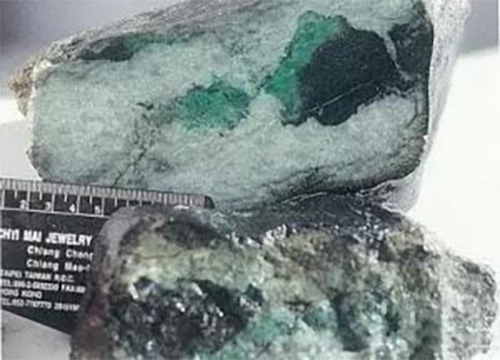
11. Fragmented Spots — A Scene of Devastation
-
Color and Shape: Fine, fragmented, and chaotic black spots and black threads that lack a distinct shape and are scattered throughout the rough stone.
-
Characteristics: This type of “mold” is the result of hydrothermal fluids permeating entirely through crystal fissures, indicating that the entire rough stone is intersected by a network of dark mineral veins.
-
Value for Gambling: Upon cutting, the interior is usually a black, dirty background with no usable value; this type of “mold” is considered unsuitable for gambling.
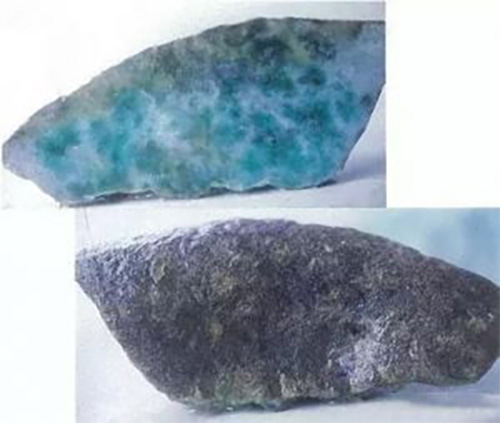
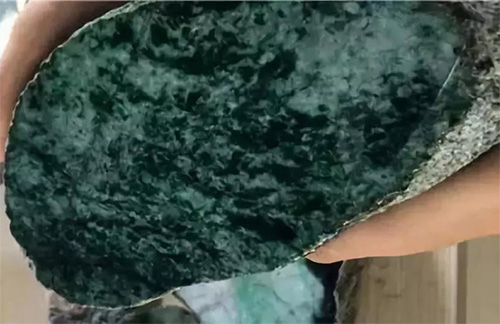
12. Full-Coverage Blemish — A Solid Mass of Black
-
Color and Shape: The entire surface of the rough stone is almost completely covered by a black “mold,” appearing jet-black or oil-black, resembling a solid block of black stone.
-
Characteristics: This indicates that the entire rough stone consists primarily of amphibole, sodium-chromium pyroxene, and other minerals, with very little jadeite content.
-
Gambling Value: Essentially a dead black stone with no green or translucency; it has no commercial value whatsoever and is not worth gambling on.
13. White Spots (White Patches) — Fish Eyes Among Pearls
-
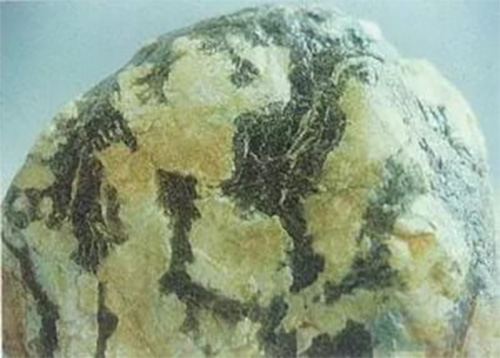
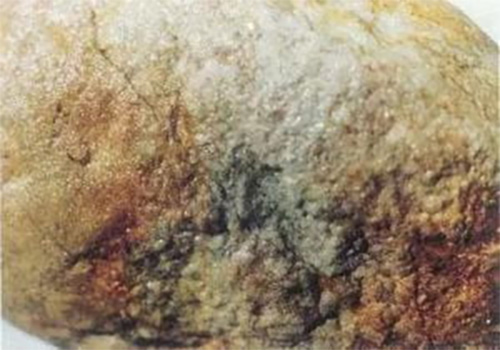
Color and Shape: White or grayish-white, appearing as flakes, veins, or irregular patches attached to the skin; some may also appear as spots.
-
Characteristics: Not composed of dark-colored minerals; primarily consists of light-colored mineral veins—such as calcite, dolomite, or feldspar—that have filled the stone later. It lacks translucency and feels rough to the touch. It does not participate in chromium metamorphism and is unrelated to the formation of green jade.
-
Value in Jadeite Speculation: Offers no indication of internal green color; it is purely a useless vein embedded within the jade flesh that only affects the purity of the jade. If encountered, it can be safely ignored.
III. The Reference Value of “Suan” in Jadeite Speculation
"Shan" is a double-edged sword; its reference value can be summarized in three points:
-
Color Indicator: The presence of “mold”—especially “live mold,” “plaster mold,” and “dried mold”—strongly suggests a high likelihood of green concentration nearby, as it indicates that chromium-bearing hydrothermal activity was once active.
-
Warning of Damage: “Pig's Bristle” spots, “Straight” spots, “Horse Tail” spots, and “Full-Coverage” spots are like internal “cancer cells.” Their presence signals the destruction of the intact jade body, and such gambling stones must be decisively abandoned.
-
Depth and Type Assessment: The depth of invasion can be inferred from the morphology of the “mold”—those that lie flat against the surface are typically shallow, while columnar formations that penetrate deeply are certainly deep. By shining a light on the edges of the “mold” to observe the transparency of the green, one can distinguish between “live” and “dead” “mold”; this is the surest method for betting on color.
In practice, one must bear in mind the dialectical relationship: “Black follows green, and blemishes devour green.” Blemishes are a gluttonous feast for chromium; they may present the owner with a rich, vibrant emerald green, or they may devour all color entirely.Understanding every fine vein and every nuance of depth on the “mold” is the core skill that elevates jadeite gambling from mere speculation to true mastery.
Friendly Reminder: Gambling on jade carries significant risks; beginners should not engage in this activity blindly.