


Man-Made Jadeite and Its Identification
I. A Few Introductory Remarks
Jadeite is loved by many, but few truly understand it.Natural jadeite (known in the industry as "Grade A") is quite expensive, so some people have come up with a scheme: they take low-quality, worthless stones and "enhance" them using various methods to sell them at a high price. This is what we commonly refer to as artificially treated jadeite, also known as "Grade B," "Grade C," or "Grade B+C."
This article will discuss what these treatment methods entail and how to identify them.
II. Jadeite\'s “ID Card”: What Do A, B, and C Mean?
First, remember these three classifications:
-
Grade A: Natural jadeite that has undergone only physical processes such as cutting, shaping, and polishing, with no alteration to its chemical composition.
-
Grade B: Jadeite that has been washed with strong acid and then filled with resin.
-
C-grade: Jadeite that has been artificially dyed.
-
B+C Grade: Jadeite that has been both acid-treated and resin-filled, as well as dyed.
Let\'s go through them one by one.
III. Type B: Acid Treatment and Resin Injection
How is it made?
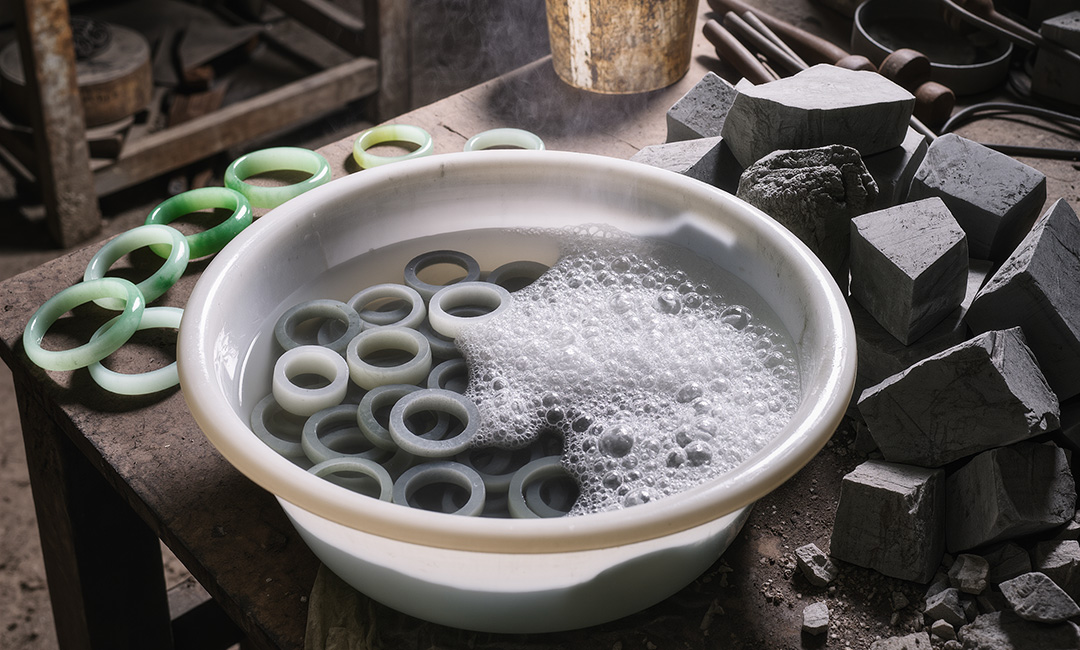
Take a piece of low-quality jadeite covered in black spots, yellow stains, and cracks (known in the trade as “brick material”) and soak it in strong acid (usually hydrochloric or sulfuric acid).The acid corrodes away the impurities and discoloration inside, making the stone appear clean. However, the acid also corrodes the original structure, creating numerous cracks and tiny pores, leaving it as porous and fragile as a sponge.
It is then placed in a vacuum chamber, where the air is removed and transparent epoxy resin (a glue-like organic polymer) is injected to fill the gaps. Finally, it is heated to cure, hardening the resin and making the stone appear solid and translucent.
What are the characteristics?
-
Appearance: The stone has an overall whitish or grayish tint that looks unnatural. Some surfaces exhibit “crazing”—a dense network of fine cracks resembling parched farmland.
-
Sound: When tapped lightly with a coin, natural jadeite produces a crisp, resonant sound, while B-grade jadeite sounds dull and short, like tapping plastic.
-
Luster: Natural jadeite has a vitreous luster—bright and sharp. B-grade jadeite has a waxy or resinous luster, giving it a slightly oily, hazy appearance.
How to Identify (Key Points)
-
Examine the Surface: Using a 10x magnifying glass (a common tool in jewelry stores), you\'ll notice that the surface of B-grade jadeite has acid-etched mesh-like patterns, resembling the cracks in mud on a dried-up riverbed—dense and interconnected in a net-like formation. The surface of A-grade jadeite is smooth, with occasional fine scratches left by polishing, but no such mesh patterns.
-
Examine the color: The color of B-grade jadeite sits on the surface and lacks “depth.” The green of natural jadeite has “depth”—the color transitions from deep to light, with the darker areas appearing as if they have penetrated deep into the stone.
-
Listen to the sound: Suspend the jadeite from a fine string and gently tap it with another piece of jadeite or a metal object. B-grade jadeite produces a dull, "thudding" sound; natural jadeite produces a crisp, "ting—" sound with an echo. (Note: This is most noticeable with bracelets; pendants are less effective for this test.)
-
Examine the interior: Shine a strong flashlight at an angle. The internal structure of B-grade jadeite appears blurry, like viewing flowers through a mist, with a distinct gel-like texture. In natural jadeite, you can see a clear interwoven fibrous structure, resembling intertwined cotton balls.
IV. C-Grade: Artificially Dyed
How is it made?
Low-quality jadeite is heated to open the crystal fissures, then soaked in chemical dyes (chromium salts were previously used for green, but now all colors are available). The dye seeps into the fissures, turning the white stone “green.”
How to Identify It
-
Examine color distribution: The color in C-grade jadeite follows cracks or grain fissures, resembling the way watercolor bleeds on paper. Under a magnifying glass, the color appears as a mesh-like pattern concentrated within the fissures. In natural jadeite, the green forms in patches and clusters; it does not specifically seek out the cracks.
-
Examine the color roots: C-grade jadeite lacks distinct color roots; the edges of the color are blurred, and the overall tone is uniform with no variation in depth. Natural jadeite features varying shades of green, with visible “growth” patterns.
-
Use a Charles filter (a specialized gemstone viewing filter): Older C-grade jadeite dyed with chromium salts will turn reddish-brown under the filter. However, note that many modern dyes do not change color, so this method is not 100% reliable.
-
Examine under a UV light: Many C-grade jades exhibit bright white or bright yellow fluorescence under a UV light (the kind used to check currency). Most natural jades show no fluorescence or only very faint fluorescence.
-
Wipe with alcohol: A very small number of poorly dyed stones will lose their color if wiped with a cotton swab dipped in alcohol. However, most will not, so this method only works on the lowest-quality stones.
V. B+C-Grade: Washed and Dyed
This combines the processes used for B-grade and C-grade jadeite. First, the stone is acid-etched and resin-injected, with dye mixed into the resin and injected together, or the stone is dyed first and then resin-injected.
To identify these, combine the methods described for Grade B and Grade C products: look for both acid-etched mesh patterns and color bleeding along the cracks.
VI. Several “Unconventional” Treatments
1. Coated Jadeite (Dressed Jadeite)
A layer of green gel-like film is applied to the surface of colorless or light-colored jadeite, as if the stone were wearing a green "coat."
Identification: Under a magnifying glass, the surface shows bubbles (similar to a poorly applied phone screen protector). The coating is soft, and a fingernail can scratch it. Natural jadeite cannot be scratched.
2. Wax Infusion (Minor Treatment)
Natural jadeite is soaked in paraffin wax, which seeps into microscopic cracks to conceal flaws and enhance luster. This falls between Grade A and Grade B jadeite and is highly controversial. Strictly speaking, minimal wax immersion is still considered Grade A, while extensive immersion is classified as treated.
Identification: Touch the surface with a hot needle (a heated steel needle); the wax will melt into a small pit, and you\'ll smell the wax. Natural jadeite is not affected by a hot needle (though, of course, don\'t actually burn it).
VII. Three Most Practical Tips for the Average Person
We\'ve covered a lot above, and you might not remember it all. So just remember these three points:
First, look at the price. Jadeite with good texture and color cannot be cheap. If you see a “ice-type full-green” bracelet selling for just a few hundred yuan, don\'t even bother looking—it\'s definitely fake.
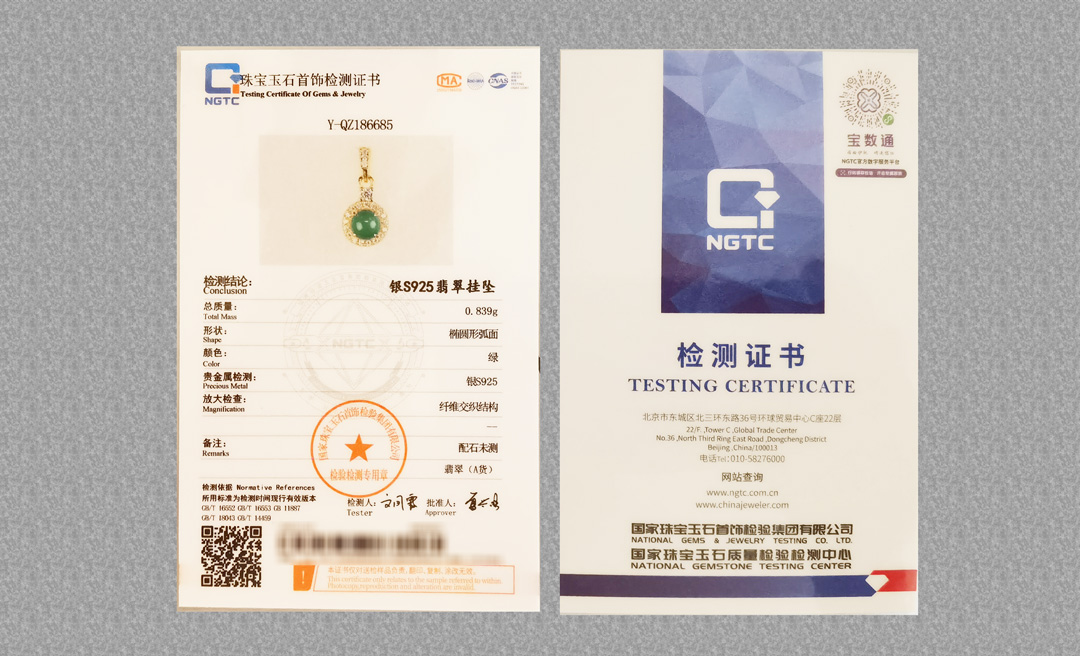
Second, check the certificate. When buying jadeite, you must have a certificate issued by an authoritative institution (such as the National Gemological Testing Center (NGTC) or a provincial testing center). The certificate will clearly state whether it is “Jadeite (Grade A)” or “Jadeite (Treated).”Note: If the certificate simply says “Jadeite” without parentheses, it may not necessarily be Type A; you must check the remarks section.
Third, learn to identify “acid-etched mesh patterns” and “color roots.” These two characteristics are the most reliable indicators. If you learn to use a 10x magnifying glass, you\'ll be able to spot about 70–80% of treated jadeite.
VIII. Final Thoughts
This isn\'t to say that treated jadeite should never be purchased. If you\'re simply looking for something attractive to wear for fun, buying a B-grade or C-grade piece for a few dozen dollars is perfectly fine. However, the seller must clearly inform you that it is treated.
The real concern is paying the price of an A-grade piece only to end up with a B-grade one. That\'s being scammed.
So, remember this: When you\'re unsure, trust the certificate, not the sales pitch. No matter how persuasive the seller\'s claims may be, don\'t make a purchase without an authoritative certificate.
Note: The methods described in this article can serve as a preliminary reference, but jadeite identification requires long-term practical experience. For valuable jadeite, it is recommended to have it appraised by a reputable jewelry testing institution.